Seed situation in Uganda
Our learning phase of tracking spoilage
In Uganda, there is an ongoing narrative of farmers buying poor quality seed that fails to germinate.
Counterfeit seed is often cited as a cause of this problem but damaged seed is also thought to be an issue.
Damage has been suggested to occur during seed logistics but the stress conditions seed bags experience across the system are not clearly known, nor where they occur and how they vary across different networks, other than the fact that temperature and humidity profiles will be dominant factors.
Knowing these risk patterns of spoilage will allow industry and policy to address the avoidable cost of farmers investing in seeds that won’t grow.

Ugandan formal and informal seed sectors
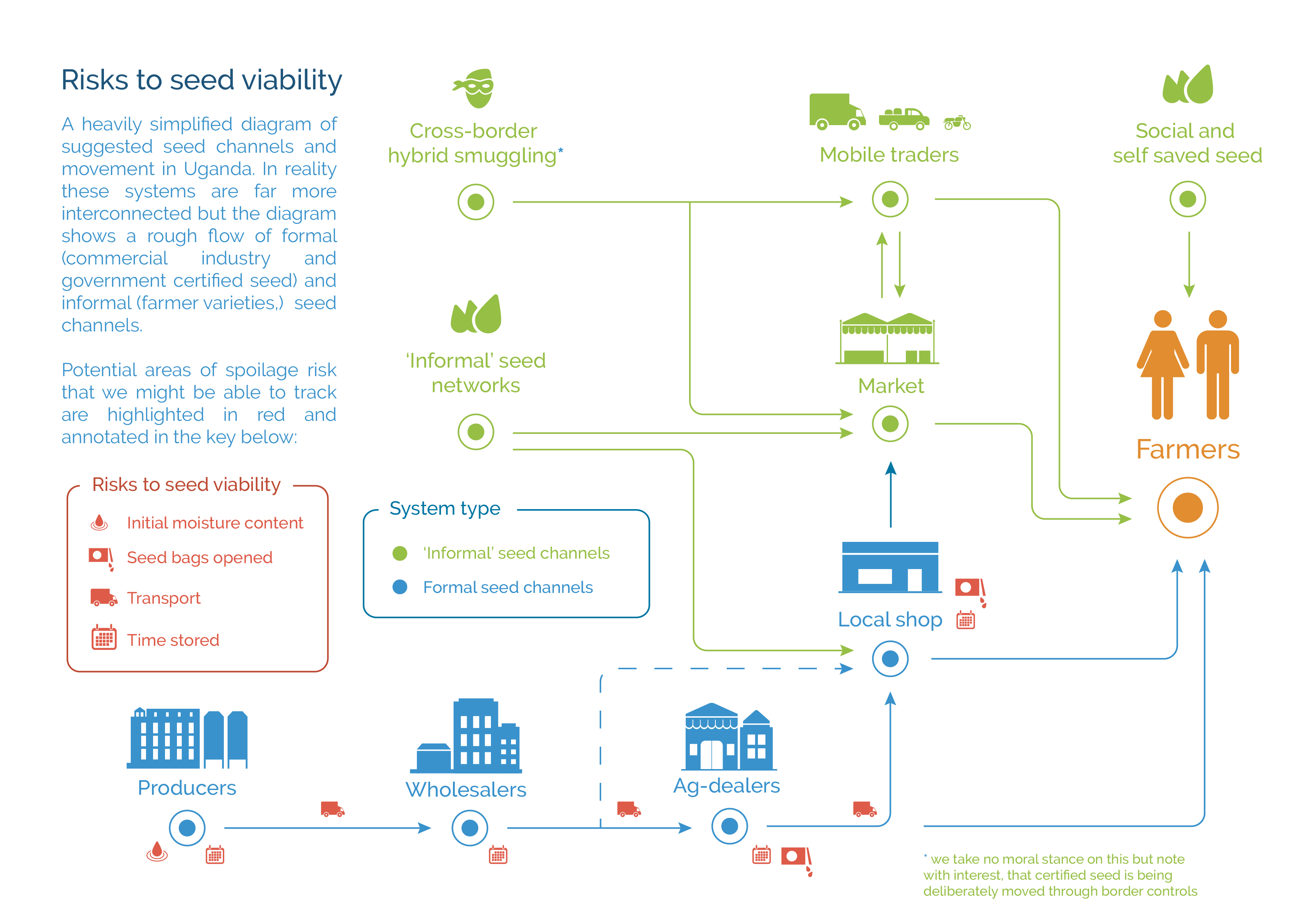
Ugandan seed systems are a complex mix of channels and sources. Often the literature organises these systems by the label ‘formal channels’ or ‘informal channels’.
Formal channels are generally those relating to modern, certified varieties from commercial seed industry, government and seed aid.
Informal channels on the other hand are those including farmers’ own saved seed, local varieties and those obtained through social networks. These informal channels provide the majority of seed for Ugandan smallholders.
In reality, farmers obtain seed from both these sources and the borders between what is termed formal or informal can be fuzzy at the edges. One key point for this project however is related to packaging.
Our device aims to travel with bags of seed. In many informal systems however, bags are broken up for distribution. This poses a number of challenges but ones that we aim to investigate.
Our first phase prototype will likely track the lifetimes of sealed bags, generally associated with the formal sector. Our findings from this work will inform how we might track spoilage once bags are broken up.
Fake seed
One commonly cited risk to seed quality is the belief that a percentage of the seed in circulation is fake. This is attributed to traders buying seed from less reputable sources and panting the seed to look like the certified variety. The traders then still claim it is hybrid seed and farmers are reported to find it difficult to distinguish the truthfulness of these claims.
It is however still not clear whether some of these issues are entirely counterfeit seed, or poor quality or damaged seed. It could also be a mix of all these things at the same time.
Farmers could in theory receive seed that is the wrong variety, but still display similar characteristics and subsequently believe it might be the right variety. Farmers might experience poor germination rates and may not know what causes it. This might mean attribution errors (“this is fake seed”) may easily occur.
Barriga and Fiala (2018) find that seed when it leaves the seed companies is generally of good quality, and so is the seed that is sold around Kampala (where the seed companies are based) but that when it reaches districts further away, there is a marked drop in quality. This holds regardless of whether the seed is purchased at wholesalers or retailers (and even regardless of whether the seed is broken up).
This suggests that en route to the districts, things happen during transport (hot trucks, multiple offloading and loading that cracks the seed) and/or during storage (moisture, temperature, senescence, exposure to daylight) that greatly affect seed quality. Purity of the seed was not an issue, which suggests that in their sample malicious counterfeiting is not as much of an issue is previously suggested.
Seed Spoilage in the system
In the process of seed production and sale, the seed is checked just after development for certification but then rarely checked after this point.
Post-certification issues are when the product has been seen to have met the minimum requirements for certification and has been sent for market. Issues in the supply chain of transport, storage and improper handling of the seed do however occur. These might be factors such as when seed is in the company store room after certification, such as the temperature and moisture environment.
Testing at certification stage is conducted by the government ministry but not at the local and farmer levels. Further checking at the seed agents might be possible, but this is likely limited
There is a feeling from the private sector that they are limited in their capacity to measure seed spoilage in the system despite pressure from the government and policy. This is combined with general feeling of lack of capacity of regulatory staff and equipment to test the seed throughout the supply chain, rather than just at the start.
Farmers have been complaining that the seeds they have bought is fake and have been requesting the private sector to check for counterfeits but the private sector often don’t have testing equipment.
Ugandan seed companies don’t just produce nationally. One example of an international chain from Uganda is to Sudan where batch identity remains. It is not well know how spoilage affects international shipments.
